How to Work with a Remote MVP Team
You are on your third coffee, juggling Notion tabs and Figma files, staring at a Slack thread with a developer on the other side of the planet. And then it hits you:
“How do I even make this remote MVP team actually work?”
Many first-time founders think outsourced app development is just “hire someone, sit back, and wait for the work.” SPOILER: It is not.
Working with a remote MVP team is a skill and the startups that nail it are not merely lucky. They follow frameworks for communication, collaboration, and delivery that actually work.
We have broken it all down: from choosing the right remote development team to setting up feedback loops that make your MVP investor-ready.
Why Can a Remote MVP Team Be a Turning Point?
Hiring an in-house team is not cheap, and scaling globally is even harder. The #1 solution here is the offshore development startups.
According to Global Workplace Analytics (GWA), a typical employer can save ≈ US $11,000 per year per employee by adopting remote or hybrid work (less office space, utilities, overhead).
A solid remote MVP team gives you:
- Global talent without the overhead. You get top developers from anywhere without relocating.
- Speed + agility. You get small and focused teams that can iterate faster than big internal squads.
- Cost efficiency. Early-stage founders love not paying full-time salaries.
But remote does not mean hands-off. If you don’t have communication frameworks in place, your MVP might end up late, buggy, or… worse, completely misaligned with your vision.
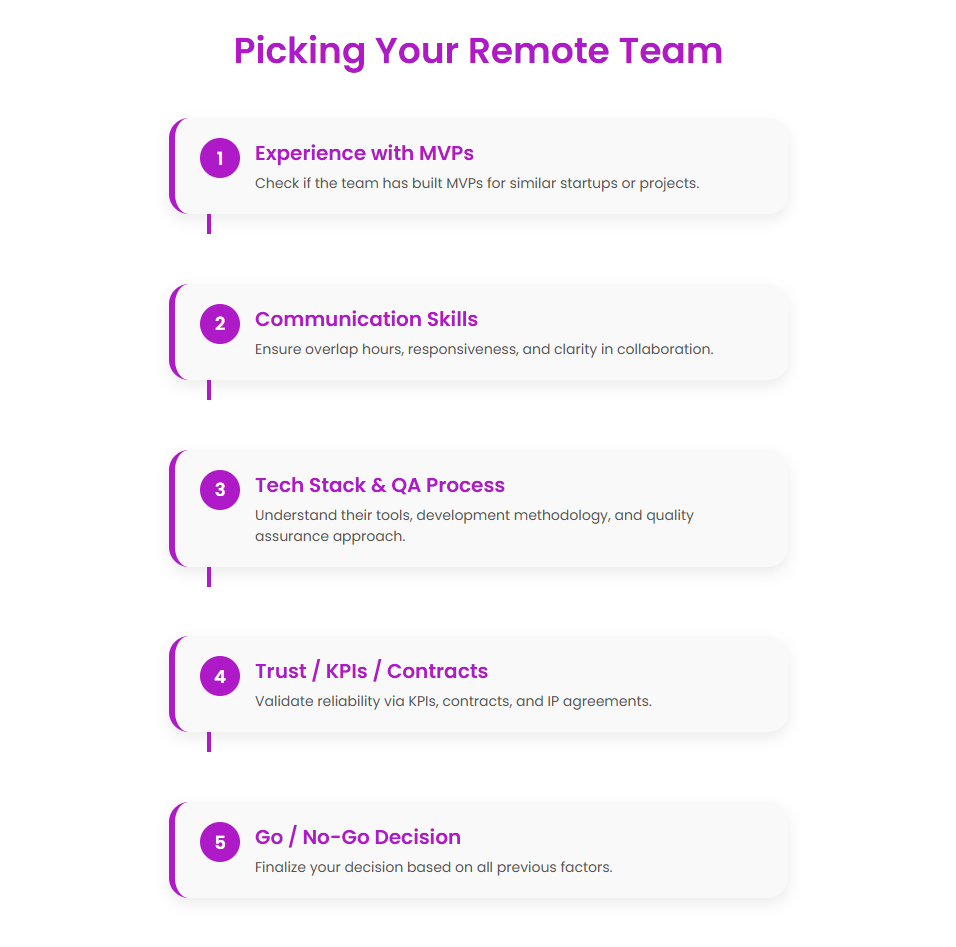
These steps/tips will help you in choosing a remote MVP team:
Step 1: Pick the Right Remote Development Team
Chemistry + capability when choosing a remote MVP team. You want someone who gets your vision and can execute.
And don’t forget to ask these questions:
- Have they built MVPs before, especially for startups in your industry or with a similar scope?
- Can they communicate clearly in your time zone or at least overlap a few hours each day?
- What’s their tech stack, QA process, sprint methodology, and how do they handle unexpected blockers?
Look for tangible proof: case studies, demos, references from clients who were in your shoes.
And don’t underestimate trust: clear contracts, defined KPIs, and ironclad IP agreements are non-negotiable.
A team can be brilliant but if you can’t rely on them legally and professionally, the partnership won’t last.
Step 2: Nail Communication Before You Code
Remote teams fail when communication fails. It sounds simple, but it’s the #1 reason startups miss deadlines or deliver half-baked products.
This is the framework we swear by at Doerz Tech:
a) Onboarding
- Kickoff workshop: one day to align vision, roles, and priorities.
- Central hub: all docs, design files, and product roadmaps in one place (Notion, Confluence, or Figma).
- Introductions: everyone shares working hours, preferred tools, and response expectations.
b) Daily + Weekly Syncs
- Short standups (live or async) to track progress.
- Weekly demos: even if it is half-built, show what’s working.
- Retrospectives: talk about what went well and what needs fixing.
c) Async Tools
Slack, Trello, Jira, GitHub, Miro, Figma, whatever makes sense. The key is one source of truth for every conversation, task, and design decision.
Remote work doesn’t mean lower output. Several studies and surveys indicate remote/hybrid teams often maintain or even increase productivity compared to traditional office setups.
Step 3: Keep the MVP Lean and Focused
It is tempting to ask your remote team to build “everything now.”
Don’t.
Rule #1: Only build what solves the core problem. Not features, not bells and whistles: the absolute must-haves.
Map your core user journey and block all distractions. Every extra feature adds friction and friction kills momentum for both users and investors.
At Doerz Tech, we often see founders succeed when they:
- Sketch wireframes before a single line of code. Visual thinking prevents wasted effort. Pick the right MVP features set.
- Prioritize 1–2 core workflows, the ones that deliver the most value to early users.
- Test with 20-50 real users before scaling. Feedback beats assumptions every time.
Even Dropbox started with a 3-minute demo video. That was their “MVP.” Simple, focused, and impactful.
This also shows you the importance of building a minimum viable product (MVP) to validate ideas efficiently before scaling.
Step 4: Build Fast Feedback Loops
As your product develops, your remote MVP team learns what works and what doesn’t. You need to build feedback loops, and you can do that when you:
- Conduct weekly user interviews to validate assumptions.
- Push small updates frequently, don’t wait for “perfect” features.
- Track every insight. What works, what confuses, what delights.
- Document decisions and experiments so the whole team learns from every iteration.
The faster you iterate, the faster you learn and that’s exactly what investors want to see. What investors really fund is your speed and skill in solving real user problems, not the lines of code.
Non-technical founders can apply these tips by following the steps to build MVP for non-technical founders so the team learns and iterates quickly.
Step 5: Transparency = Trust
Remote work thrives on transparency. If your team hides progress, you panic. If your team over-promises, you miss deadlines. Avoid both.
Doerz Tech uses:
- Weekly dashboards: sprint progress, velocity, bug counts, upcoming work
- Milestone check-ins: each feature or phase has a clear go/no-go
- Team rituals: virtual coffee, retros, and shout-outs to keep engagement high
Trust grows when everyone sees what’s happening in real time.
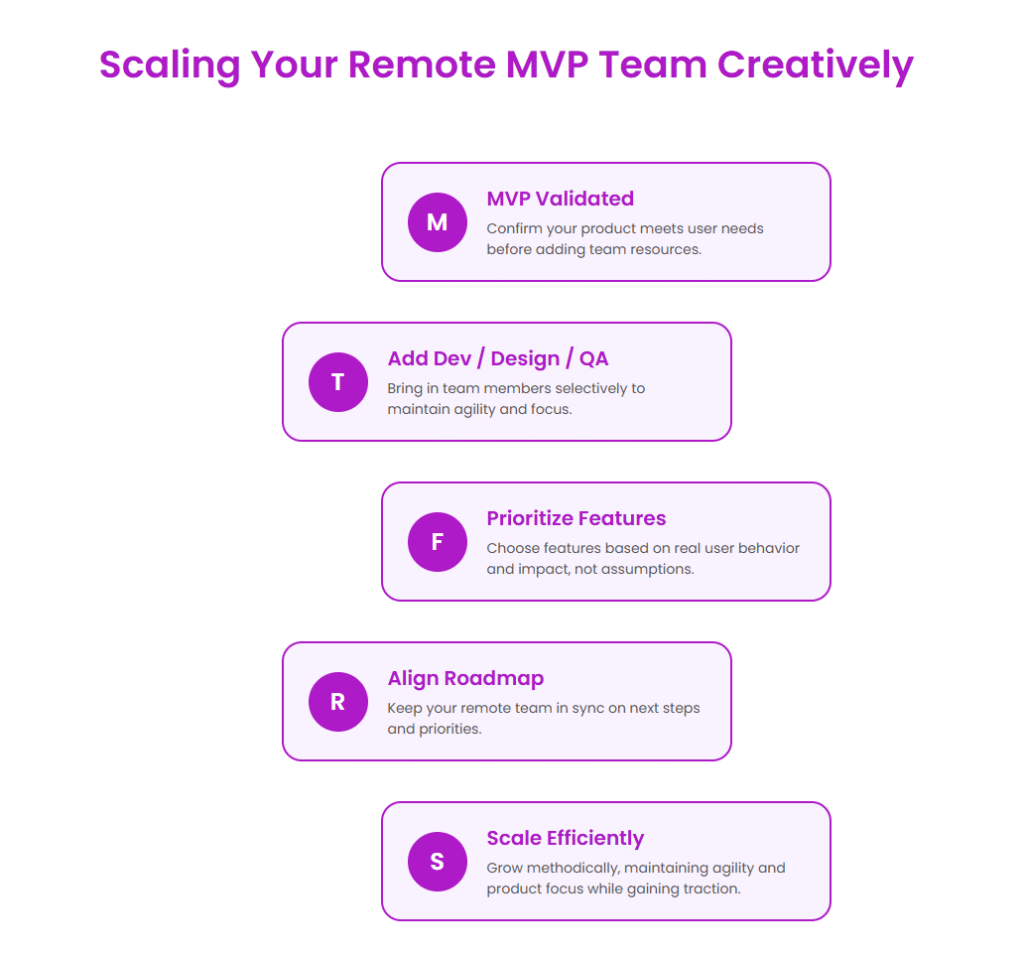
Step 6: Scale Smart
Once your MVP is validated, scaling is not that tough, it’s a method. Startups often succeed in growth and pivots by using structured frameworks to find the right direction.
- Add developers, QA, or designers only when needed
- Prioritize features based on real user behavior, not assumptions
- Align roadmap sessions with your remote team so everyone sees the next moves
Remote MVP teams can flexibly scale up or down without slowing the product. The faster you scale smartly, the faster your product can capture traction and attention, from users and investors alike.
Step 7: Plan for Continuous Improvement
Building an MVP is ONLY the beginning. A remote MVP team is only as effective as your ability to keep learning, iterating, and evolving your product. Think beyond the first release:
- Regular retrospectives and post-mortems. After each sprint or milestone, analyze what worked, what didn’t, and how your team can improve.
- Invest in tech debt management. Don’t let shortcuts pile up. Schedule time to refactor, optimize, and update your codebase.
- Invest in tech debt management: Don’t let shortcuts pile up. Schedule time to refactor, optimize, and update your codebase.
The goal is to turn your MVP from a temporary experiment into a resilient and evolving product.
Continuous improvement ensures your remote team stays productive, your users stay happy, and your investors see a product that grows and adapts.
4 Common Pitfalls Associated with Remote MVP Teams & How to Avoid Them
Even the best founders stumble when working with a remote MVP team.
Most mistakes are preventable if you know what to watch out for.
These are the common pitfalls we see and how to sidestep them:
1. Overloading the MVP with unnecessary features
It’s tempting to ask your team to build everything now but more features usually mean slower delivery, more bugs, and confused users.
Focus on the core problem your product solves. Map out your users’ main journey and stick to features that directly serve it.
Remember: less is more, especially for an MVP.
2. Micromanaging instead of trusting frameworks
Checking in every hour might make you feel in control but it kills team morale and slows down progress. Remote teams thrive when they know what to build and when to deliver, not how to breathe.
Set clear goals, KPIs, and deadlines. Let your team own the “how.”
Use structured sprints, daily standups, and dashboards to stay informed without hovering.
3. Poor onboarding leading to misalignment
Skipping the “who does what and why” phase often results in developers building something very different from your vision. Misalignment costs time … and sanity.
Run a thorough kickoff: introduce everyone, share workflows, define roles, and clarify expectations.
Centralize all docs, designs, and specs in one place so there’s no guessing.
4. Ignoring cultural and time zone differences
A missed message or late reply isn’t laziness. It might just be 3 a.m. in your developer’s time zone. Overlooking these differences can create frustration and slow down your MVP.
Define overlapping hours for live communication.
Respect local holidays and schedules. Keep async communication clear and documented, so no one is waiting for answers that take hours or days.
Final Note!
The value of a remote MVP team goes beyond speed and cost. It’s in how they execute with trust and clarity, only if you focus on product traits that make an MVP investor-ready
If you do it right, your MVP can move from idea → prototype → investor-ready product without headaches.
At Doerz Tech, we combine outsourced app development with frameworks that make offshore development startups feel local. Clear communication, structured sprints, fast feedback loops, and shared vision.
At the end of the day, a strong remote team helps bring your product to life, prove your concepts, and expand with you. With Doerz Tech, you get a remote MVP team that is 100% like an extension of your own startup. Trusted, reliable, and fully aligned with your goals.