You launched your project with excitement. New team, clean designs, clear goals.
At first, everything looked promising… until tasks kept rolling over to “next sprint.” Your build started feeling slow, buggy, or simply off from your vision.
Communication nonexistent. Deadlines slipped quietly.
Did I hire the wrong development team?
Most founders don’t realize they have partnered with a bad development partner until weeks, sometimes months, into the project. By then, timelines are slipping, budgets are expanding, and the product looks nothing like what you imagined.
Once you know the red flags, you can fix the situation fast and get your product back on track.
We have listed down the biggest signs you hired wrong, plus the exact playbook to recover quickly and, if needed, switch app agency without blowing up your startup roadmap.
8 Startup Development Red Flags: Why is Picking the Wrong Development Team Common?
Hiring an app team is tricky, especially for first-time founders. On paper, everyone promises:
“fast delivery,” “top quality,” “best price.”
And somewhere between “We are still testing” and “We will push the update tomorrow,” a thought hits you:
But behind this sheer marketing are, maybe, the teams that may lack structure, reliability, or the experience required to build a real startup-grade MVP.
A bad development partner sets your entire product strategy off course. Deadlines slip. UX breaks. Moments that should be exciting become stressful.
You need to know when to walk away, and when to recover the relationship.
McKinsey reports that IT projects go over budget 45% of the time and exceed timelines 7% of the time, because the wrong team was selected from the start.
So let’s go straight into the red flags.
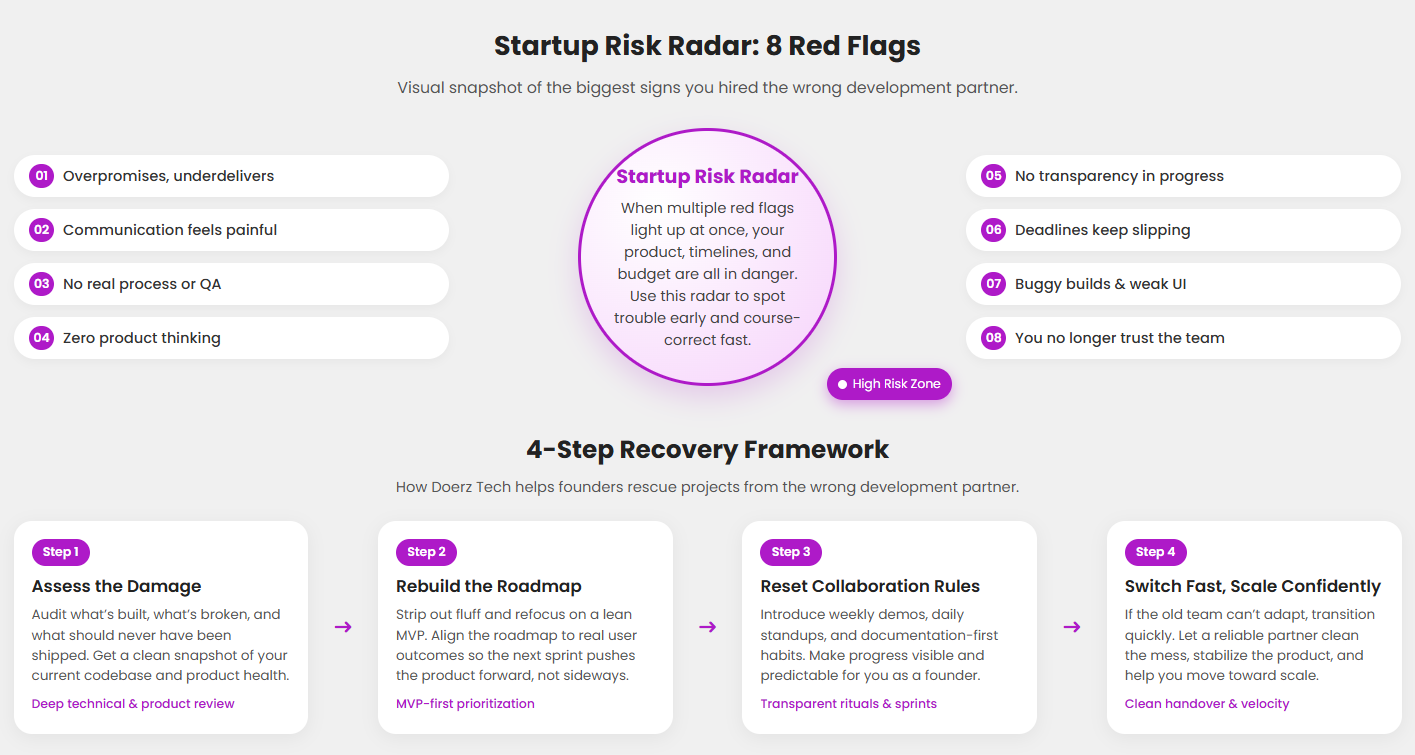
Sign 1: Your Team Overpromises but Underdelivers
A classic mark of a bad development partner is big promises followed by disappointing output.
They say: “Two weeks max.” But three months later, the core features barely work.
It’s dangerous because when a team constantly overpromises, you lose predictability and predictability is the backbone of startup execution.
Gartner highlights that software teams underestimate timelines by as much as 50%, which is why overpromising is one of the clearest signs of a bad development partner.
You can fix it fast:
- Demand clear sprint plans with deliverables
- Set non-negotiable deadlines
- Move to weekly demos. If things don’t improve, it may be time to switch app agencies.
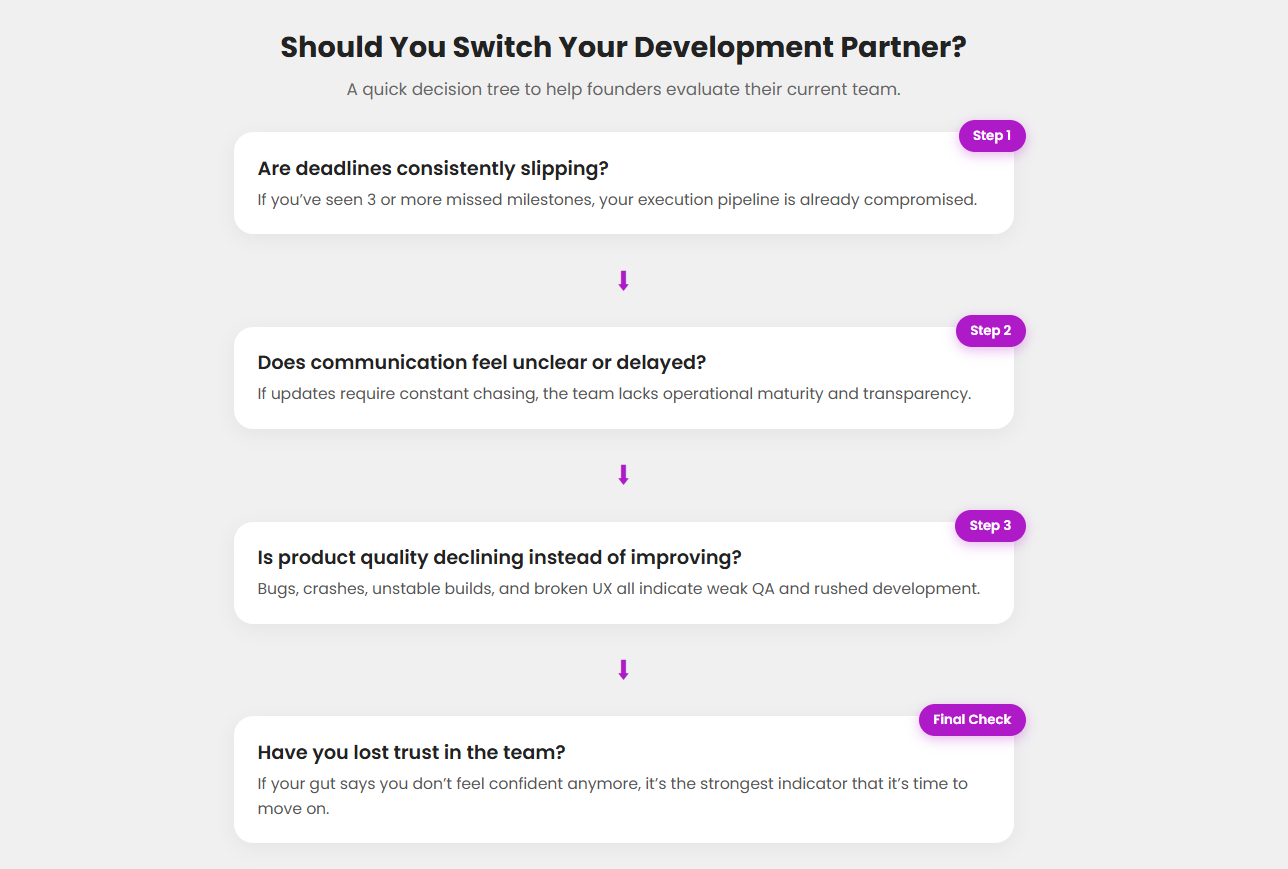
Sign 2: Communication Feels Like Pulling Teeth
If you need to chase your team for updates, you are already dealing with a bad development partner.
Delayed messages. Vague replies. No proactive communication.
This is one of the biggest startup development red flags because communication issues lead to misalignment, scope issues, and surprise delays.
In fact, Harvard Business Review confirms that poor communication raises the risk of project failure by 44%, which makes it one of the deadliest startup development red flags.
- Establish daily standups (live or async)
- Set response-time expectations
- Create a single source of truth: Notion, Jira, or Trello. Communication should make your life easier, not harder.
Sign 3: No Structured Process, Just Chaos
A bad development partner often lacks a clear workflow. You will see things like:
- No sprint cycles
- No QA process
- No code reviews
- Random releases
Your app starts looking like a patchwork of rushed decisions. Demand a visible sprint board. Require staging builds. Introduce weekly demos. A real team has structure.
Many communication problems get worse when teams operate across time zones, so understanding how to work with a remote MVP team becomes essential.
Sign 4: They Build Without Asking “Why”
Your developers say “yes” to everything but never challenge assumptions.
This is one of the most subtle startup development red flags, because it looks like cooperation, but it’s actually a sign of a bad development partner lacking product thinking.
Strong teams rely on real user behavior to guide decisions, and using user feedback during MVP validation keeps the build aligned with customer needs instead of guesses.
A strong team helps shape your vision, not just execute random tasks.
- Share user flows and real-user feedback
- Invite them into product discussions
- Ask for technical justification before building. If they still “just follow orders,” the relationship may never mature.
Sign 5: No Transparency Into Progress
You can ask, “Where are we with the build?” And you will get answers like:
“Almost done.” “We are testing.” “Just fixing something small.”
None of these means anything.
A bad development partner hides behind vague updates because they lack structure or control.
This is when founders start thinking: “Do I need to switch app agency before this burns down?”
- Ask for weekly dashboards
- Use burn-up/burn-down charts
- Track scope creep versus actual delivery
Sign 6: They Miss Deadlines Repeatedly
One missed deadline is normal. Two are concerning. Three or more = a clear sign of a wrong fit.
Consistent delays are the easiest way to spot a wrong development partner. It happens because of poor planning, overcommitting, a lack of senior developers, and weak internal management.
- Re-evaluate scope and timeline
- Introduce hard milestones
- Make every sprint review mandatory. If deadlines continue slipping, start planning your transition.
Sign 7: Quality Is Terrible. Lots of Bugs, Poor UI, Crashes
Your app is technically “done”… but crashes on launch. Or features break randomly. Or UI elements look nothing like your Figma. This is another textbook symptom of a bad development partner.
Startups can’t afford bad quality. It kills user trust and investor confidence.
- Demand QA reports
- Require test cases for each feature
- Introduce staging builds for review. Quality must be non-negotiable.
Sign 8: You Don’t Trust Them Anymore
This is the final and most important sign. Once trust is broken, everything else becomes difficult.
If you constantly feel: Uneasy. Unsure. Suspicious. Drained.
…you are likely dealing with a bad development partner, even if you ca
n’t pinpoint one single issue.
- Have a reset meeting
- Re-align expectations
- Set new conditions for the partnership
If trust doesn’t return, it’s time to switch app agency and restart clean with a reliable team.
So… What Should You Do If You Have Already Hired the Wrong Development Team?
This is the 4-step recovery framework we use at Doerz Tech to rescue founders from a bad development partner and put the project back on track.
Step 1: Get a Full Assessment
You need a clear picture of:
- What’s built
- What’s broken
- What’s missing
- What was over-engineered
- What should have never been built
This helps you understand whether the existing team can still be salvaged or if you should switch app agency.
A simple roadmap is especially important when building an MVP as a non-technical founder because it helps with confusion and keeps development focused.
Step 2: Clarify Your Product Roadmap
Simplify everything. Focus on what truly matters.
This is where many founders realize the previous team added fluff that didn’t serve the MVP. A roadmap gives direction, speed, and control and makes it easier to spot a wrong development partner again in the future.
During the assessment, you may realize the product needs a directional shift, and having a clear approach to pivoting your product in the right direction helps prevent repeating old mistakes.
Step 3: Reset the Collaboration Framework
Set strict rules:
- Weekly demos
- Daily standups
- Documentation-first workflow
- Transparent sprint goals
- QA before delivery
If your current team can adapt, great. If not, it’s confirmation that you have been dealing with a bad development partner.
Step 4: If Needed, Switch Fast. Don’t Drag It
Dragging a failing relationship only increases stress and cost.
Founders often wait too long because they fear:
“Will switching agencies cost even more?”
“Are we going to lose time?”
“Will a new team understand my vision?”
But when you switch app agency at the right time, you actually save: money, time, momentum, sanity.
A good team can take over quickly, audit the code, fix the mess, and help you scale with confidence.
How to Avoid Bad Teams in the Future?
If you have been burned once, you definitely don’t want a repeat. The easiest way to protect your next project is to screen your team before you sign anything.
These checks make it far easier to spot a wrong development partner before you commit and save yourself from another painful rebuild.
1- Proven MVP experience
You want a team that has actually shipped products, not just talked about them. Moreover, look for examples of apps or platforms they have built from scratch.
If they have been through the process before, they will know how to handle the inevitable surprises that come with early-stage development.
2- Clear communication habits
A good team keeps you in the loop without you having to chase them. They have regular check-ins, updates over Slack or email, and clear ways to ask questions. You will avoid those moments where you are left guessing what’s happening with your product.
3- Solid references and case studies
Past work tells you a lot about what they can do. Ask to speak to previous clients or see real case studies.
If they can’t show you proof of success, it’s risky to assume they will deliver for you.
4- Transparent pricing and scope
No one likes surprise bills or scope creep. A trustworthy team lays out the budget, timeline, and deliverables upfront.
That way, you both know exactly what you are getting and what it will cost.
5- Structured QA and testing
A good product is tested thoroughly. They should be testing early, often, and documenting every bug or fix. This prevents last-minute disasters and keeps the product stable as it grows.
6- Collaborative product mindset
You don’t want coders who just follow instructions. A strong team challenges ideas, gives advice, and thinks with you about the product. They become partners in building something that actually works in the real world.
7- Good documentation culture
Everything should be written down. Flows, decisions, features. Because, relying on memory is a recipe for confusion later.
With solid documentation, anyone on the team (or new members) can jump in without losing context.
Final Note
Hiring a bad development partner can feel discouraging, frustrating, and expensive.
But it’s fixable. Fast.
With clear frameworks, structured communication, and the right team, your product can go from messy → stable → investor-ready in no time.
At Doerz Tech, we help founders recover from failing development partnerships and rebuild momentum with a team that feels like an extension of their own startup. Transparent, reliable, and aligned from day one.
If you are thinking you might need to switch app agency, or you’ve spotted some early startup development red flags, trust your instincts and act quickly.
Your product deserves a team that builds with clarity, speed, and confidence.
And we have made that happen for 60+ startup founders. We have been there, building products from scratch and figuring out what really works. So, when you work with us, you get a partner that treats your vision like their own.