You are staring at your laptop at 2 a.m., sketching your product roadmap, thinking you finally understand the next 12 months… and then something shifts. A new AI model drops. A competitor launches a feature you had not even imagined. Investors start asking questions that didn’t exist last year. Suddenly, you realise the future of startups is moving faster than your plans can keep up.
This is the moment most early-stage founders feel the punch of startup tech trends in 2026.
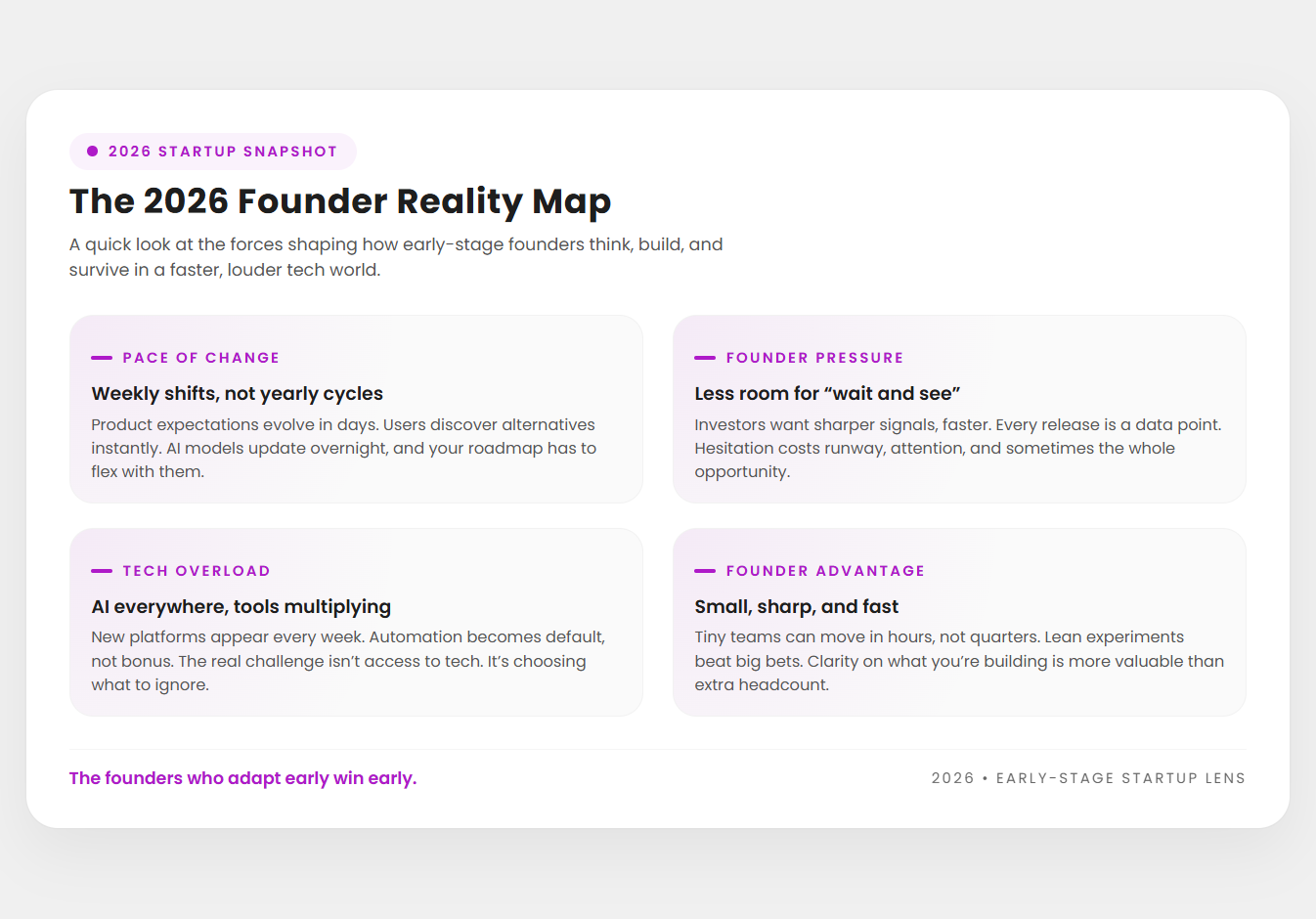
Because 2026 is not going to be “another year” in tech. It is a wave. A reset. A push into a world where AI, automation, data, and user expectations evolve weekly. Not yearly. The 2026 technology trends shaping this new wave are already changing how teams hire, how products are built, and how early-stage companies survive their first brutally competitive year.
You don’t need to chase trends like a panicked founder grabbing every tool on Twitter.
You just need to understand what tech trends will impact startups in 2026. Which emerging startup technologies for 2026 are actually worth adopting. How AI and automation will shape startups in 2026 without blowing your budget or overwhelming your product roadmap.
As soon as the patterns make sense, startup tech trends in 2026 shift from noise to guidance.
The New Reality: Why 2026 Feels Different for Founders?
CB Insights analysed 101 startup post-mortems and found that 42% of startups failed because they were “not solving a market need”. Basically, building something people never really wanted in the first place.
You can feel that number in 2026, when every wrong product bet gets punished faster, and mostly if you have ever dealt with a bad development partner who made early decisions harder instead of clearer.
A few years ago, you could ship a basic SaaS app, run some ads and slowly figure things out. Today, the future of startups is shaped by users who expect intelligence, personalisation and speed on day one. They compare your tiny product with category leaders in a single swipe.
This is why startup tech trends in 2026 feel less like hype and more like a reality check. The founders who thrive are the ones who adapt quickly instead of trying to hold on to the old way of doing things.
The Pressure Behind the “Future of Startups”
Every pitch deck in 2026 will have at least one slide on AI, automation or data because markets are demanding efficiency. The future of startups is being judged by one core question: can you do more with less?
Investors, customers, and even potential hires are quietly benchmarking you against the most important 2026 technology trends:
- Can your product learn from user behaviour?
- Can your operations run lean, automated, and async?
- Could you build trust while handling data at scale?
If your answer is “not yet”, that’s okay. This is the moment to prepare.
Core Startup Tech Themes You Can’t Ignore in 2026
Let’s break down the big currents shaping the future of startups and what they mean at the very early stages.
1- AI as a Co-Founder, Not Just a Feature
For many founders, AI used to be a “nice to have” feature. When you look at startup tech trends in 2026, it plays such a central role that it feels less like a tool and more like part of your founding team.
From Hype to Everyday Workflow
Generative models, smarter search and recommendation systems are changing how products are built and used. According to McKinsey’s State of AI in 2025 survey, 88% of organisations now use AI in at least one business function, up from 78% the year before. It’s gone from experiment to everyday infrastructure in less than a year.
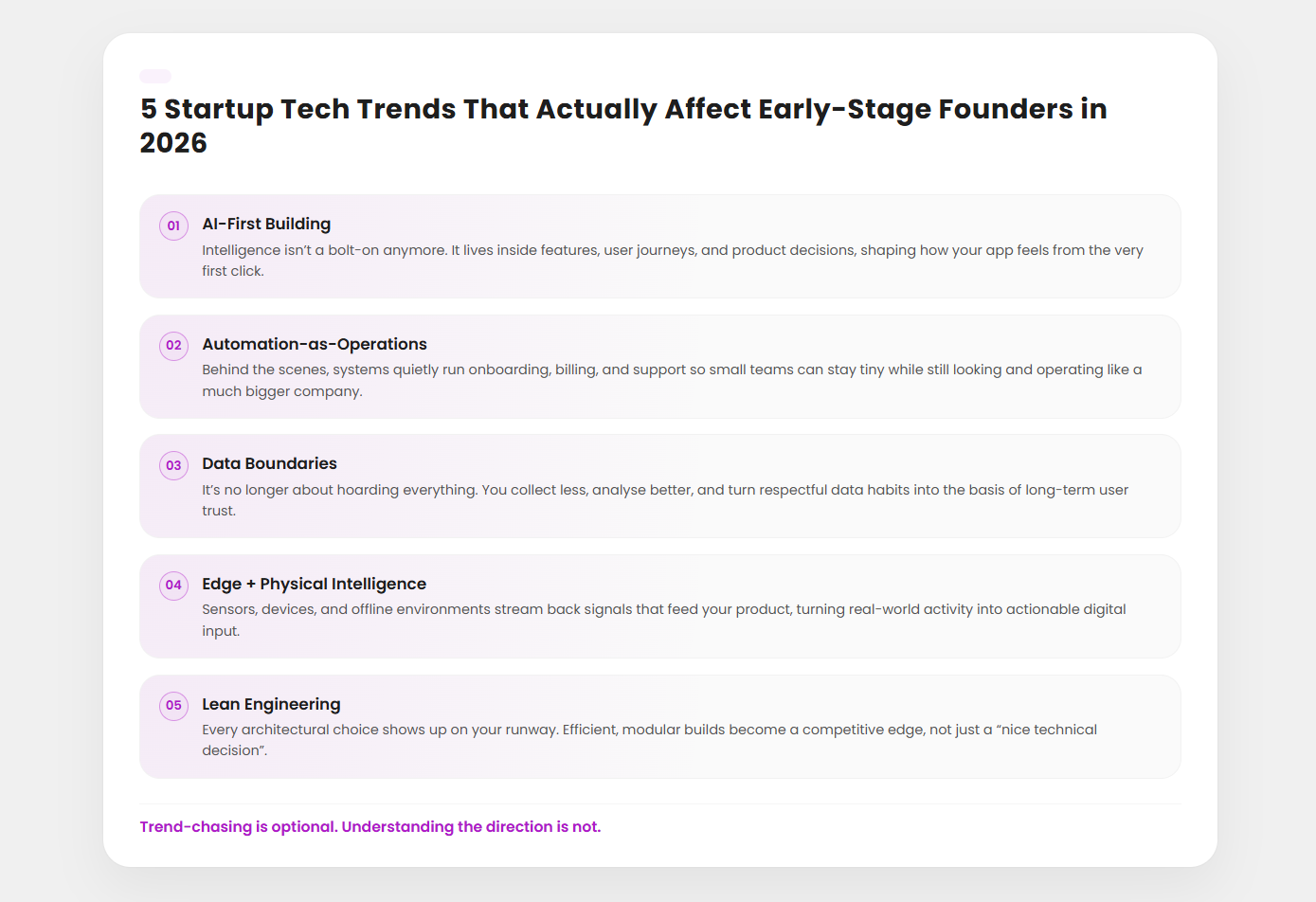
One of the most underrated 2026 technology trends will be AI behind the scenes. Scoring leads, prioritising tickets, summarising calls, and flagging churn risk.
This is also how AI and automation will shape startups in 2026. Not by adding clever buttons, but by compressing the work your team has to do across support, marketing and product discovery.
Where Early-Stage Founders Should Start with AI
Many founders only realise how deeply this affects their product once they start identifying the core traits of an investor-ready MVP, because AI shifts what “ready” even means.
You don’t need a research lab. As part of the broader future of startups, your job is to:
- Automate repetitive and low-value work first.
- Add AI where users feel immediate value (search, recommendations, insights).
- Treat AI decisions as “assistive” until you are confident in the data.
2- Automation and Lean Teams
If there’s one phrase that sums up what tech trends will impact startups in 2026, it’s this: tiny teams, huge leverage.
Ops That Run Themselves (Mostly)
From onboarding flows and billing to customer success and internal reporting, no-code and low-code tools are quietly becoming critical emerging startup technologies for 2026. It’s the same pattern you see when founders build their first Minimum Viable Product, where speed and clarity matter more than scale.
They let you:
- Ship workflows without waiting on dev cycles.
- Test processes with 10 users before you scale to 1,000.
- Keep your burn rate low while you search for product–market fit.
The founders who truly understand startup tech trends in 2026 are the ones who see automation as a way to buy back focus, not just reduce headcount.
3- Data, Privacy, and Trust by Design
One of the quieter but powerful 2026 technology trends will be the move from “collect all the data” to “collect what you can defend”.
Cisco’s 2024 Consumer Privacy Survey found that more than 75% of consumers say they won’t buy from a company they don’t trust with their data, and 49% of people aged 25-34 have already switched providers because of data-sharing practices. Trust isn’t a “nice to have” anymore. It is a conversion.
Trust is Now a Product Feature
With tighter regulations and more privacy-aware users, the future of startups will favour founders who:
- Explain clearly what they track and why.
- Offer sane, transparent consent and opt-out flows.
- Store and secure data as if a breach would end the company (because it might).
This is not optional anymore. In many categories, trust will decide whether people even try your product.
4- Edge, Devices, and Real-World Intelligence
You will also see startup tech trends in 2026 playing out far away from dashboards. On devices, sensors, and “dumb” physical systems becoming smart.
Startups That Touch the Offline World
No matter if it is logistics, health, retail, or manufacturing, the most interesting future of startups will blend:
- Lightweight hardware or sensors.
- Cloud services for processing and dashboards.
- Local or edge computing to keep things fast and reliable.
You don’t have to be a hardware-focused company. But you do need to understand how your product interacts with the real world, not just a browser.
5- Sustainability and Cost-Aware Engineering
Another thread running through 2026 technology trends is simple: waste is out, efficiency is in.
Hosting costs, compute usage and energy footprints all matter now, to your margin, to regulators and to a growing group of climate-conscious customers. Modern infrastructure forces founders to ask:
“Can we do this smarter, cleaner, and cheaper?” every single quarter.
3 Emerging Startup Technologies for 2026
Rather than throwing around trendy terms, let’s look at emerging startup technologies for 2026 in the places where early-stage founders will actually notice their impact.
1- SaaS and B2B Startups
For SaaS founders, startup tech trends in 2026 are making products:
- More autonomous (self-healing systems, smart alerts).
- More contextual (AI-generated insights inside workflows).
- More collaborative (built-in async communication and hand-offs).
If you are building in this space, the future of startups is pointing you toward:
- Deep integration with the tools your customers already use.
- Opinionated workflows that reduce decision fatigue.
- Analytics that explain “why”, not just “what happened”.
2- Fintech and Money Movement
Regulation, fraud prevention, and embedded finance are at the centre of many 2026 technology trends.
If payments, lending, or subscriptions touch your product:
- Expect stronger identity and risk checks.
- Look for infrastructure that abstracts complexity.
- Design for cross-border users from day one.
The future of startups in fintech is less about wild experiments and more about resilient and compliant infrastructure that still feels simple for users.
3- Health, Bio, and Regulated Spaces
Some of the most important startup tech trends in 2026 live here: AI-assisted diagnostics, remote monitoring, personalised plans, and automation in clinical workflows.
Building in these spaces means:
- Designing with regulation in mind from day zero.
- Prioritising explainable AI over black-box magic.
- Treating security and audit trails as core features.
Here, the future of startups belongs to teams that respect the rules but still find creative ways to move faster than incumbents.
What Tech Trends Will Impact Startups in 2026 the Most?
There’s plenty of noise about 2026 technology trends but only a handful actually reshape what you do day to day as a founder.
1- How Your Team is Built
Smaller core teams, more specialist freelancers, and AI tools doing the “glue work” in between. That’s the shape of the future of startups. You will hire fewer generalists and more people who can orchestrate systems and just operate them.
This shift mirrors what’s happening across industries as AI and automation reshape the foundation of modern tech, not just at the startup level.
2- How You Design Your Product Roadmap
Startup tech trends in 2026 force you to:
- Ship thinner and more opinionated versions of features.
- Prioritise anything that improves retention or reduces support.
- Delay vanity features until core workflows feel magical.
Your roadmap becomes less about “what can we build?” and more about “what can we maintain and learn from quickly?”
3- How You Talk to Investors
Investors are reading the same reports on 2026 technology trends. They want to see:
- That you know which trends are real vs. hype.
- That your stack can flex with new tools, not collapse.
- That AI and automation support your economics, not just your marketing.
In short, the future of startups belongs to founders who can translate big trends into simple, credible plans.
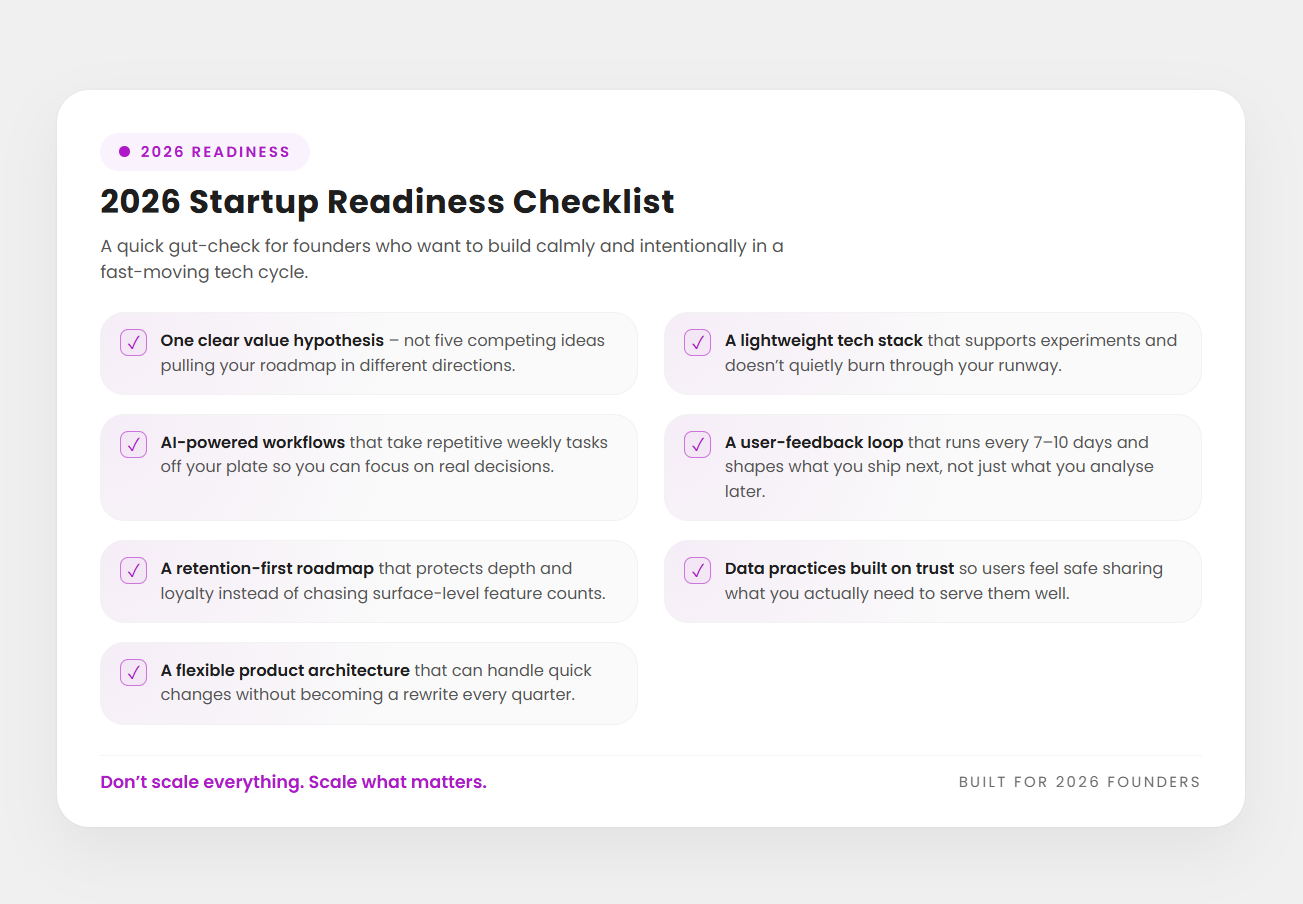
A Practical Playbook: Preparing for 2026 Without Burning Out
It’s easy to feel overwhelmed at this point. So let’s make it real and tactical.
Step 1: Audit Your Current Stack
List every core tool you use across product, ops, marketing, and analytics. Then ask:
- Where are we doing manual work every single week?
- Where could AI or automation safely assist?
- Where are we over-engineering?
This framing connects startup tech trends in 2026 directly to your next sprint instead of some abstract future.
Step 2: Choose Two Bets, Not Ten
You don’t need to master all 2026 technology trends. Instead:
- Pick one AI/automation bet that improves daily execution.
- Pick one product bet that aligns with the clearest future of startups in your niche.
Treat everything else as “nice to watch, not to chase”.
Step 3: Build Learning Loops, Not Just Features
The founders who really benefit from emerging startup technologies for 2026 obsess over learning:
- Instrument your product so every release teaches you something.
- Talk to users weekly, not quarterly.
- Turn analytics, support tickets, and sales calls into a single feedback stream.
Final Thoughts!
The future of startups will always feel a bit chaotic from a distance. Things will move fast, tools will evolve overnight and the market will keep shifting. But when you understand the 2026 technology trends that stay lean and keep talking to your users, you start creating something rare in this space: clarity.
Clarity gives you momentum.
Clarity gives you confidence.
Clarity helps you build without losing your mind.
That’s why so many early-stage founders lean on Doerz Tech. Not just to write code but to help shape the right software at the right stage. We have seen founders come in overwhelmed by choices, budgets and timelines and walk out with a product strategy that actually feels doable.
No matter if it is designing an MVP, validating an idea or turning a rough concept into something real, we help founders build software that supports their vision instead of complicating it.
In the end, that’s what you want. A calm and focused company moving through a very loud world. One deliberate release, one real customer conversation and one thoughtful decision at a time.