7 MVP Development Lessons in 2025: (How Founders Can Win in 2026)
2025 was not an easy year to build a startup.
Funding tightened. User expectations rose. AI accelerated everything while simultaneously raising the bar for quality. Many founders shipped faster than ever. Yet fewer felt confident about what they had actually learned.
The founders who survived were the ones who paused, reflected, and adjusted how they built MVPs from the ground up. The MVP development lessons in 2025 revealed were less about speed and more about intention.
Why 2025 Changed How MVPs Are Built?
According to Crunchbase data, global venture funding showed fluctuations in 2025. Some months experienced sharp declines.
It underscores a more cautious investor scenario than the previous years.
For years, the startup playbook was simple:
Ship fast. Iterate faster. Figure it out later.
In 2025, that advice stopped working.
Markets became less forgiving. Users churned faster. Investors asked sharper questions. MVPs were no longer judged by existence but by direction. All part of the larger shifts in early-stage founder strategies for MVP development in 2026.
One of the most important MVP development lessons is that speed without learning is just expensive motion.
The startups that struggled were misaligned.
This shift defines many of the startup learnings for 2025 that now shape how successful founders are planning ahead.
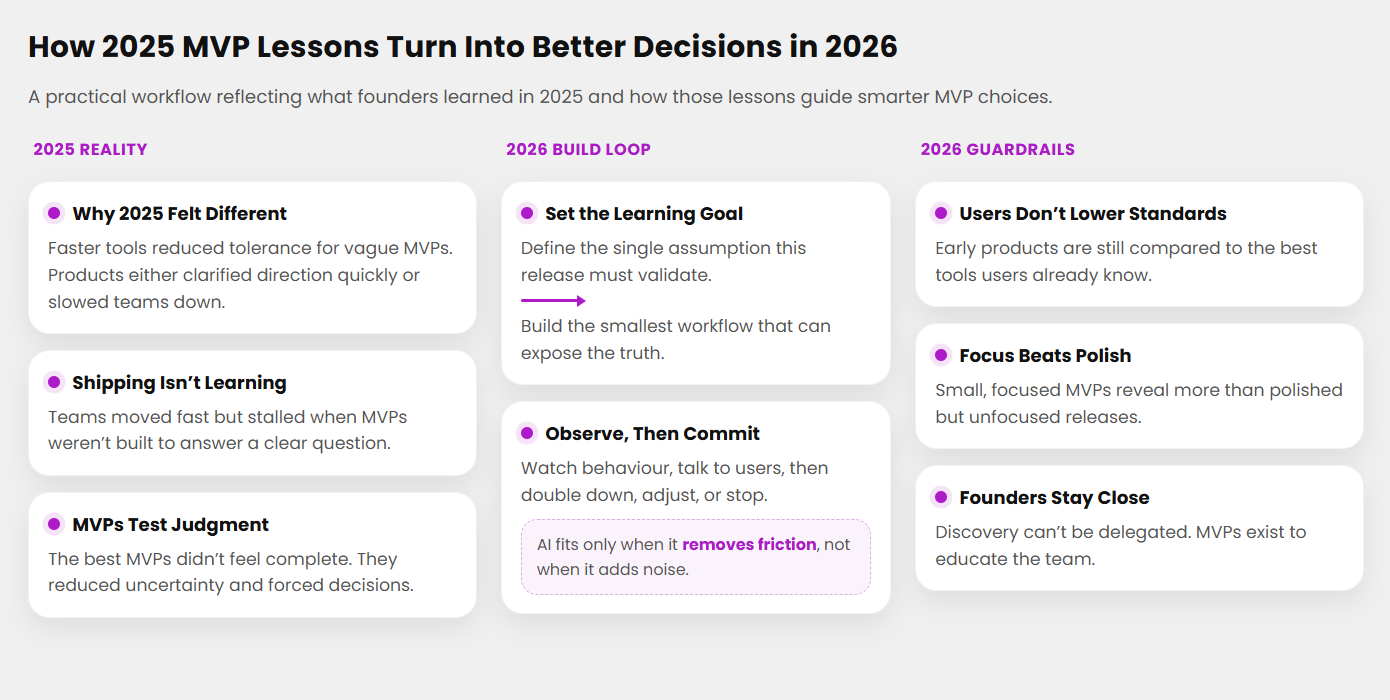
Lesson 1: MVPs Are No Longer “Mini Products”
In 2025, many founders built MVPs that looked impressive but failed to answer a single clear question.
They added dashboards, settings, and secondary features before validating the core problem. This approach killed momentum.
What founders learned in 2025 is that an MVP is not a smaller version of the final product. It is a learning instrument.
- MVPs built around one job to be done
- Clear hypotheses tied to each feature
- Ruthless scope reduction
This shift is one of the defining MVP development lessons in 2025 and directly informs the most important MVP trends that will be on top in 2026.
Lesson 2: Validation Beats Velocity
2025 exposed a harsh truth:
Shipping weekly means nothing if users don’t care.
Founders learned (often painfully)that velocity without validation leads to burn, not insight. This realization sits at the core of many startup learnings in 2025.
The strongest teams slowed down just enough to ask:
- What are we trying to prove?
- Which decision will this data unlock?
- What happens if we are wrong?
That mindset shift defines what founders learned in 2025 more than any tool or framework.
Data shows roughly 42% of startups fail because there’s no real market need for their product. This shows how critical early validation is…. exactly the lesson many founders learned painfully in 2025.
Lesson 3: Users Don’t Want Features, They Want Relief
Another major MVP development lesson was how quickly users abandoned products that added complexity instead of clarity.
Startups that survived focused on:
- Reducing friction
- Solving one painful moment
- Removing unnecessary choices
This directly influences current MVP trends. Simplicity and focus are outperforming feature-heavy MVPs.
Founders finally accepted that “more” is rarely better. A core part of startup learnings in 2025.
Lesson 4: MVPs Need Strong Product Thinking, Not Just Code
In 2025, many founders outsourced coding without embedding product thinking. It shows the impact of a mismanaged dev team on MVP outcomes, a bad development partner, per se.
The result was:
- Technically correct MVPs
- Strategically weak products
One of the clearest 2025 insights is that MVP success depends more on decisions than execution.
Strong MVP Teams in 2025 Did This:
- Challenged assumptions
- Asked “why” before building
- Used real user behavior to guide scope
This lesson has reshaped how founders approach MVP development and is directly influencing MVP trends in 2026.
Lesson 5: Metrics Without Meaning Are Useless
2025 was full of dashboards. And full of confusion.
Many startups tracked dozens of metrics but couldn’t explain what success actually looked like. This disconnect became one of the most repeated startup learnings across early-stage teams.
Founders realized too late that:
- Metrics should answer questions
- Not every number deserves attention
- One north star beats ten vanity stats
This clarity is now a cornerstone of MVP development lessons and a defining driver.
Lesson 6: Iteration Must Be Intentional
Iteration was misunderstood for years. In 2025, that misunderstanding caught up with many teams.
Iterating without direction led to:
- Conflicting feedback
- Bloated backlogs
- Product confusion
One of the most valuable realizations is that iteration must be guided by learning goals. Not by anxiety.
This principle now anchors many of the startup learnings that experienced founders are carrying forward.
Lesson 7: MVPs Need to Earn Trust Early
Users in 2025 were less patient than ever.
Buggy MVPs, broken flows, or unclear onboarding immediately damaged credibility. Founders learned that “it’s just an MVP” is no longer an excuse.
Tracking errors and maintaining error-free functionality can dramatically improve user trust.
This is one of the most practical MVP development lessons in 2025:
Quality is part of validation.
This expectation is directly shaping MVP trends in 2026. Early polish and reliability are becoming non-negotiable.
4 MVP Trends of 2026 that Founders Are Already Adopting
By the end of 2025, many founders reached the same conclusion:
“We didn’t fail because we moved too slowly. We failed because we moved without clarity.”
That realization is shaping how MVPs are being built in 2026. These trends are about behavioral shifts grounded in the hard lessons of the previous year. Each is a direct response to what founders learned in 2025 the hard way.
1- Leaner MVP Scopes; Complexity Hid the Truth
In 2025, many MVPs became overbuilt in the name of “covering every use case.” Features piled on, and feedback became harder to interpret. Startups learned that more features don’t mean better learning; they often just obscure what users actually need.
In 2026, founders will be:
- Shipping fewer, more focused features
- Removing edge cases that don’t matter for validation
- Designing MVPs around a single, critical use case
2- Stronger Problem Statements Before Any Code Is Written
One of the hardest lessons from 2025 was that MVPs often failed because the problem itself wasn’t clearly defined. Teams could explain the solution, but struggled to answer:
- Who exactly has this problem?
- When and where does it show up?
- What happens if it isn’t solved?
Today, the trend is:
- Writing explicit problem statements before building
- Mapping the precise pain points users face
- Aligning the entire team around a single “why.”
A sharper problem statement means every feature, test, and experiment has a clear purpose. Something founders realized too late in 2025.
Strong engineering decisions are equally critical when building a scalable web application that can handle real user growth without breaking
3- Tighter User Feedback Loops: Actions Over Words
Listening to users is not the same as understanding them. In 2025, many teams relied on vague feedback like “it’s cool” or “looks interesting,” which didn’t help them learn.
In 2026, the founders are:
- Observing real user behavior instead of just opinions
- Tracking actions in-app rather than taking requests at face value
- Using feedback to validate decisions, not justify assumptions
The emphasis is on behavioral data, not polite feedback. It reflects a key insight from what founders learned in 2025.
4- Better Collaboration Between Product and Engineering
A common pain point in 2025 was a silent gap between product vision and engineering execution. Features were delivered, but they didn’t always align with the learning goals of the MVP.
Founders now focus on:
- Involving engineers in product discussions from day one
- Aligning every sprint with clear learning outcomes
- Treating MVP development as a joint problem-solving process
This collaboration trend is one of the strongest MVP trends, born directly from the misalignment lessons of 2025.
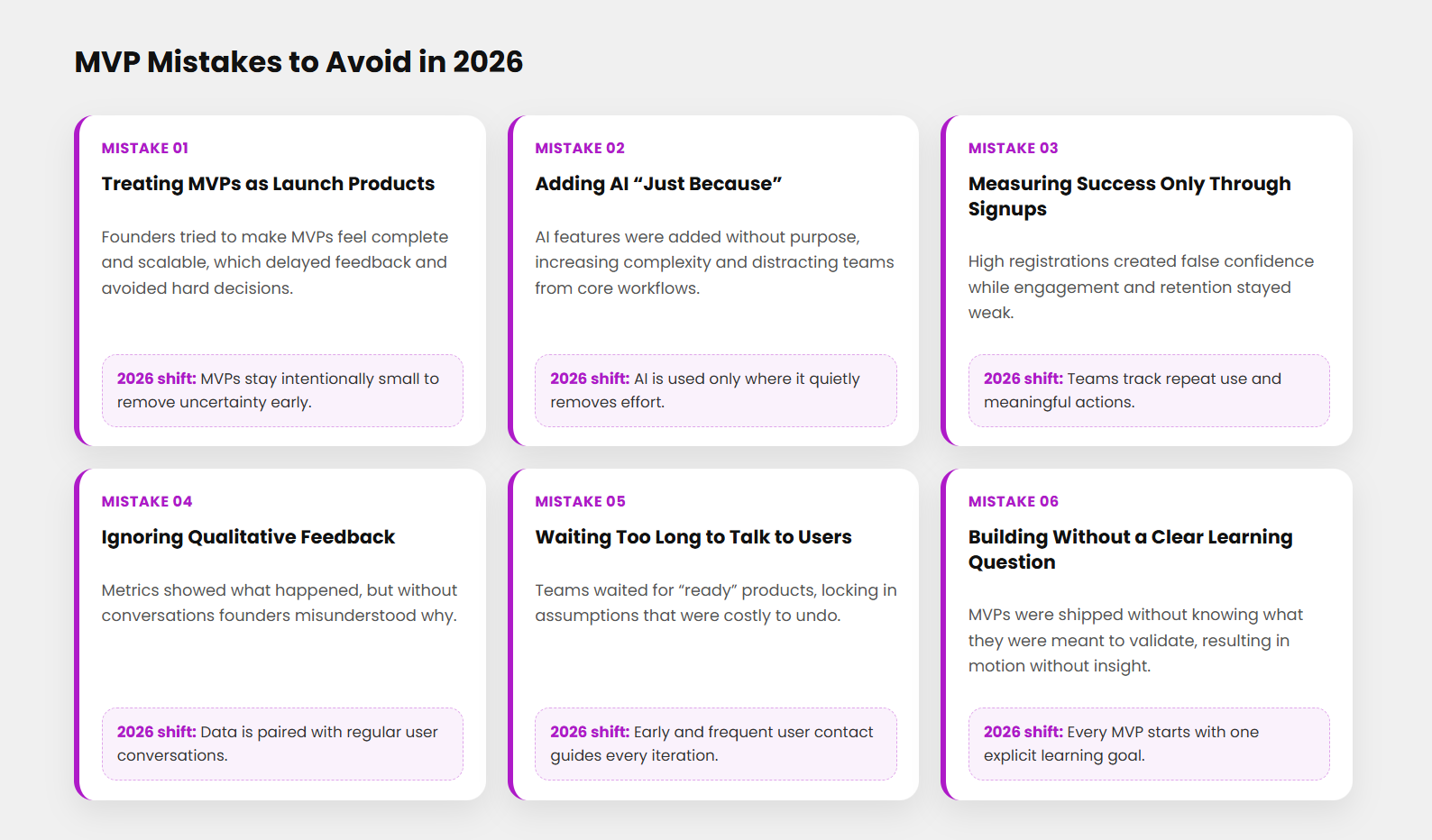
MVP Mistakes to Avoid in 2026
The founders who thrived in 2025 learned that failure often stems from repeating small, avoidable errors.
These MVP mistakes to avoid in 2026 are gold to prevent wasted time, energy and money.
1- Building Before Validating
Many MVPs in 2025 were technically impressive but strategically useless. Building without validation leads to wasted effort and misaligned features.
In 2026, avoid this by:
- Validating the problem first
- Testing assumptions with minimal effort
- Iterating only after insight is gained
2- Adding Features to Feel Progress
Activity ≠ learning.
Feature bloat was a major trap in 2025. Teams often added functionality to show progress to investors or justify burn, rather than to gather insights.
Avoid this by:
- Prioritizing features tied to hypotheses
- Killing anything that doesn’t advance learning
- Treating each sprint as an experiment, not a milestone parade
3- Ignoring User Confusion
User confusion was a silent killer. Polite feedback like “looks good” or “interesting” often masks disengagement. In 2026, MVPs should reveal friction rather than hide it.
Avoid this by:
- Observing actual user behavior, not relying on opinions
- Tracking activation and retention closely
- Iterating on the core experience before adding extras
4- Treating MVPs as Disposable
Finally, one of the biggest mistakes in 2025 was viewing MVPs as throwaways. While MVPs are “minimal,” the data they generate is irreplaceable.
Avoid this by:
- Treating every MVP as a learning asset
- Documenting assumptions, metrics, and insights
- Designing MVPs to guide decision-making, not just demo functionality
Final Note!
In 2025 was a teacher. Not a failure.
The founders who paused, reflected, and absorbed what 2025 taught startup founders are entering 2026 with sharper instincts and better discipline.
They understand now that MVPs are not about impressing investors or racing competitors. They are about learning faster than uncertainty can kill momentum.
If there is one lasting truth from all MVP development lessons in 2025, it’s this:
Clarity compounds.
And founders who build with clarity in 2026 will win.
At Doerz Tech, we help founders get their MVPs back on track, whether the project is stalled, misaligned, or just not teaching the right lessons.
Over the years, we have helped 60+ founders turn half-built products into MVPs that are reliable, scalable, and ready for real users.
We can help you win, too!